How to Price 3D Prints for Sale: Hourly Rates, Markup & Fees
Master commercial 3D print pricing with verifiable formulas for hourly machine rates, active post-processing labor, Etsy and Shopify fee gross-ups, and batch volume discounts.
How to Price 3D Prints for Sale Without Losing Money
Learning how to price 3D prints for Etsy, Shopify, craft markets, or B2B prototyping clients requires shifting from hobbyist "plastic cost" thinking to full shop-floor cost accounting. The most reliable formula for how to price 3D prints is calculating your True Unit Production Cost (filament + purge waste + electricity + machine depreciation + failure buffer + hardware inserts + active hands-on labor), multiplying by a 2.0x to 3.5x commercial markup tier, and grossing up for marketplace transaction fees. You can automate this entire calculation in seconds using our homepage 3D Print Pricing Calculator.
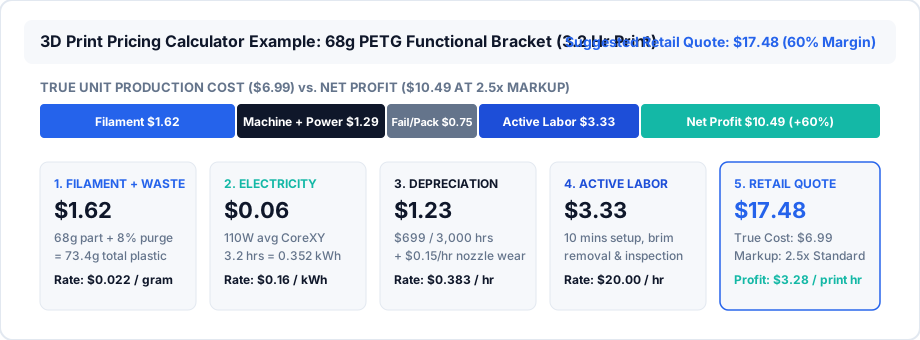
Why do so many new 3D print shops burn out after three months? Because they charge 2x or 3x raw filament cost. If a 68-gram PETG bracket uses $1.62 of filament and you sell it on Etsy for $5.00, after 10 minutes of support removal and packing ($3.33 labor), $1.29 of machine wear and power, $0.60 for a box, and Etsy's fees, you lose $2.60 on every sale. Below is the complete commercial framework for how to price 3D prints profitably.
The 3 Commercial Pricing Models for 3D Printing Services
Successful print farms and rapid prototyping bureaus use one of three pricing frameworks depending on order complexity and sales channel:
1. Cost-Plus Markup Multiplier (Best for Etsy, Shopify & Retail Products)
The Cost-Plus method calculates your exact unit cost across all five production pillars and applies a target multiplier based on product differentiation:
True Unit Cost ($) = Filament + Power + Depreciation + Failure/Box + Active Labor
Retail Price ($) = (True Unit Cost × Markup Multiplier + Fixed Fee) ÷ (1 - Channel Fee %)- Competitive Tier (2.0x Cost · 50% Gross Margin): Best for high-volume B2B batch production runs (50 to 500 units) or simple geometric parts with minimal post-processing.
- Standard Commercial Tier (2.5x Cost · 60% Gross Margin): The industry standard benchmark when deciding how to price 3D prints for online stores and local client quotes. It leaves healthy room for marketing, shipping supplies, and machine upgrades.
- Premium / Custom Design Tier (3.5x+ Cost · 71%+ Gross Margin): Best for proprietary designs, multi-color AMS sculptures, engineering filaments (Nylon PA12, ASA, Carbon Fiber), or jobs requiring custom CAD tweaks and heat-set threaded inserts.
2. Hourly Machine Rate + Material + Labor (Best for B2B Job Shops)
When engineering clients ask how much to charge for 3D printing per hour, quoting an all-inclusive hourly machine rate plus material weight is simple and predictable:
Customer Quote ($) = (Print Hours × Shop Hourly Machine Rate) + (Effective Grams × Marked-Up $/g) + Setup Fee| Printer Tier & Material Class | Typical True Machine Cost / Hr | Recommended Commercial Charge / Printing Hour | Minimum Job Setup Fee |
|---|---|---|---|
| Standard High-Speed FDM (PLA / PETG on Bambu P1S, Prusa MK4S) | $0.38 – $0.50 / hr | $2.00 – $3.50 / machine hr | $5.00 – $10.00 |
| Multi-Color AMS / MMU FDM (2 to 4 Colors) | $0.55 – $0.75 / hr | $3.00 – $4.50 / machine hr | $10.00 – $15.00 |
| Enclosed High-Temp FDM (ABS, ASA, PC, Nylon PA12-CF) | $0.65 – $0.95 / hr | $4.00 – $6.50 / machine hr | $15.00 – $25.00 |
| MSLA High-Resolution Resin (incl. IPA Wash & UV Cure) | $0.60 – $0.90 / hr | $3.50 – $6.00 / machine hr | $12.00 – $20.00 |
3. Value-Based & Minimum Profit-Per-Hour Floor
No matter what markup multiplier you choose when learning how to price 3D prints, always enforce two hard profitability floors:
- Minimum Order Charge ($10.00 to $15.00): Even a 10-gram cable clip requires customer communication, slicing, plate clearing, and invoicing. Never run a custom client job for less than $10.
- Minimum Net Profit Per Machine Hour ($2.00 to $4.00/hr): If a 12-hour print only yields $6.00 of net profit ($0.50/hr), that printer slot is underperforming. Check the Profit / Machine Hr metric in our 3D Print Pricing Calculator on every quote.
How to Price 3D Prints for Etsy, Shopify & eBay (Fee Gross-Up Table)
Marketplace fees silently take 3% to 15% of your gross revenue. When deciding how to price 3D prints for third-party platforms, you must divide by (1 - Fee %) rather than simply adding the percentage:
| Sales Channel | Fee Structure (2026 Benchmarks) | Target Net Payout Needed | Required Listed Retail Price | Total Platform Fees Deducted |
|---|---|---|---|---|
| Direct B2B Invoice (ACH / Cash) | 0% + $0.00 | $17.50 | $17.50 | $0.00 |
| Shopify Store / Stripe Checkout | 2.9% + $0.30 | $17.50 | $18.33 | $0.83 |
| Etsy Marketplace (6.5% + 3% Payment + $0.20 Listing) | ~9.5% + $0.40 | $17.50 | $19.78 | $2.28 |
| eBay Store (Final Value + Payment Processing) | ~13.25% + $0.30 | $17.50 | $20.52 | $3.02 |
How to Structure Batch & Wholesale Volume Discounts
When a B2B customer orders 10, 50, or 100 identical brackets, you can offer attractive volume discounts while keeping high hourly profitability because your setup labor is amortized across the batch:
- 1 Unit (Prototype): Full setup labor (slicing, orientation, test verification) charged to 1 unit; 0% volume discount.
- 10 Units (Small Batch): Slicing and plate setup amortized 10x; pack multiple parts onto a single build plate to eliminate inter-job cooldown delays; offer a 10% unit discount.
- 50 Units (Production Batch): Offer an 18% unit discount while sourcing filament on 3 kg or 5 kg bulk rolls (calculate bulk savings in our 3D Print Filament Cost Calculator).
- 100+ Units (Print Farm Run): Offer a 25% unit discount while optimizing overnight power draw with our 3D Printer Electricity Cost Calculator.
Review complete material and hardware benchmarks in our 3D Printing Cost Guide, or open the 3D Print Pricing Calculator now to generate and print a client-ready PDF quote.