How Does a 3D Printer Electricity Cost Calculator Work?
A 3D printer electricity cost calculator estimates the exact electrical energy in kilowatt-hours (kWh) and utility cost in dollars required to run an FDM or MSLA resin 3D printer for a single print job, per printing hour, and across an entire month of print-farm operation. Unlike basic Watt-hour estimators that assume a 3D printer runs at its maximum power-supply rating 100% of the time, our 3D printer electricity cost calculator models both the high-wattage bed warm-up phase and the PID-regulated continuous printing duty cycle.
After calculating your hourly power draw and kWh expense in this 3D printer electricity cost calculator, click "Send Wattage & kWh Rate to Full 3D Print Pricing Calculator" above to combine your electricity cost with filament weight, machine depreciation, and labor in our main 3D Print Pricing Calculator.
Why Power Supply Rating (PSU Watts) Is NOT Your Actual Printing Wattage
A common misconception among new makers is looking at a printer's 350W or 1,000W power supply label and assuming the machine consumes that much electricity every hour. In reality, a 3D printer operates in two distinct thermal stages that our 3D printer electricity cost calculator separates automatically:
- Stage 1 — Initial Bed & Hotend Warm-Up Peak (First 3 to 5 Minutes): When you start a print on an AC-heated bed printer (such as a Bambu Lab P1S/X1C or Voron 2.4), the heater pulls 300W to 950W continuously for 2 to 5 minutes until the build plate reaches 60°C (PLA) or 100°C (ABS/ASA) and the nozzle reaches 220°C–270°C.
- Stage 2 — Continuous Printing PID Duty Cycle (Remaining Print Hours): Once target temperatures are reached, the printer's PID controller pulses the bed heater at only 20% to 35% duty cycle to replace heat lost to the room, while stepper motors, fans, and the mainboard consume a steady 35W to 55W. As a result, average continuous power drops to 85W–130W for PLA/PETG and 165W–230W for high-temperature ABS/ASA.
3D Printer Electricity Cost Calculator Formulas
Every figure in our 3D printer electricity cost calculator is derived from standard electrical metering equations used by residential and commercial utility providers:
Warm-Up Energy (kWh)    = (Peak Warm-Up Watts ÷ 1000) × (Warm-Up Minutes ÷ 60)
Steady Energy (kWh)     = (Continuous Printing Watts × Bed Temp Factor ÷ 1000) × Steady Print Hours
Total Print Job (kWh)   = Warm-Up Energy (kWh) + Steady Energy (kWh)
Print Electricity Cost  = Total Print Job (kWh) × Local Utility Rate ($/kWh)
Monthly Farm Bill ($/m) = (Effective Avg Watts ÷ 1000) × Daily Hours × 30 Days × Number of Printers × Rate ($/kWh)
For example, running a Bambu Lab P1S (850W warm-up peak for 4 minutes, then 110W continuous draw for 4 hours and 56 minutes) consumes 0.599 kWh of electricity. At the 2026 US national average utility rate of $0.16/kWh, the total electricity cost for that 5-hour print job is $0.096 (less than 10 cents, or $0.019 per hour).
2026 3D Printer Wattage & Hourly Electricity Cost Benchmark Table
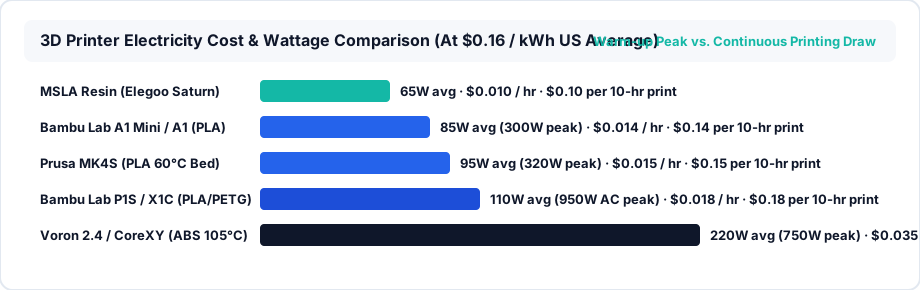
To compare hardware efficiency in our 3D printer electricity cost calculator, the table below lists measured peak warm-up wattage, continuous printing wattage across PLA (60°C bed) and ABS/ASA (100°C bed), hourly electricity cost at $0.16/kWh, and 30-day electric bill for a machine running 12 hours per day:
| 3D Printer Model | Warm-Up Peak Draw | Continuous Watts (PLA 60°C) | Continuous Watts (ABS 100°C) | Electricity Cost / Hour (PLA @ $0.16/kWh) | 10-Hour Print Job Power Cost | Monthly Bill (12 hrs/day @ $0.16/kWh) |
|---|---|---|---|---|---|---|
| Elegoo Saturn / MSLA Resin | 120 W | 65 W (UV LED) | N/A | $0.010 / hr | $0.10 | $4.49 / mo |
| Bambu Lab A1 Mini / A1 | 300 W | 85 W | N/A (Open frame) | $0.014 / hr | $0.14 | $5.88 / mo |
| Prusa MK4S / Core One | 320 W | 95 W | 150 W | $0.015 / hr | $0.15 | $6.57 / mo |
| Bambu Lab P1S / X1 Carbon | 850 W (110V) | 110 W | 175 W | $0.018 / hr | $0.18 | $7.60 / mo |
| Creality Ender 3 V3 / K1 | 350 W | 130 W | 190 W | $0.021 / hr | $0.21 | $8.99 / mo |
| Voron 2.4 (350mm CoreXY) | 750 W | 165 W | 235 W | $0.026 / hr | $0.26 | $11.40 / mo |
4 Proven Ways to Reduce 3D Printer Electricity Cost in a Print Farm
While a single printer costs only $5 to $11 per month in electricity, a 20-printer commercial farm running 18 hours a day in a high-rate region ($0.32/kWh in California or Europe) can generate $200 to $450 per month in utility bills. Our 3D printer electricity cost calculator highlights four practical ways to cut power draw by up to 35%:
- Use Cool-Tack Build Plates (35°C–45°C) for PLA: The heated build plate accounts for 60% to 75% of a 3D printer's continuous electricity consumption. Switching from a 60°C textured PEI bed to a high-grip cool plate (such as Bambu Cool Plate SuperTack or CryoGrip at 35°C) lowers continuous wattage from 110W to ~75W, cutting electricity cost by 28% to 32%.
- Enclose Printers When Printing PETG, ABS, or ASA: An enclosed chamber traps radiant heat above the build plate, allowing the bed heater's PID duty cycle to drop from 45% to under 25% and preventing draft-induced warping failures.
- Batch Full Build Plates Instead of Single Parts: Because the initial 4-minute bed warm-up draws peak wattage, printing 12 brackets on a single build plate requires only one warm-up cycle and zero cooldown gap between parts.
- Schedule Long Overnight Prints During Off-Peak Time-of-Use (TOU) Hours: Many utilities offer off-peak overnight electricity rates ($0.08–$0.12/kWh between 11 PM and 7 AM) that are 50% lower than daytime peak rates.
To see how electricity compares against filament, hardware depreciation, and labor, check our 3D Print Filament Cost Calculator, read the full breakdown in our 3D Printing Cost Guide, check commercial markup rules in How to Price 3D Prints for Sale, or quote a complete job in the 3D Print Pricing Calculator.
Maker Discussions & Pricing Tips (0)
Have a question about quoting 3D prints or tuning your cost per hour? Leave the first note below.